Neuroscientific Background
Abnormal Body Perception: Autoscopy and OBE
Autoscopic experiences (AE) and out-of-body experiences (OBE) are grouped, in the neuroscientific literature, under abnormal body perception (ABP) — disembodiment phenomena arising from altered bodily self-representation. The conventional view holds that the temporo-parietal junction (TPJ), particularly in the right hemisphere, serves as the neural hub integrating multisensory body-related information into a coherent sense of body ownership (Blanke et al., 2002). Multisensory conflict appears to be central to abnormal body perception (Ionta et al., 2011), and phenomenological changes in body ownership have been reported to follow progressive stimulation of the right TPJ (Blanke, 2000).
Subsequent research has produced more controversial findings. The left TPJ also appears to be implicated in disembodiment (Bos et al., 2016), and the TPJ is not the only region associated with abnormal body perception: the medial occipitoparietal junction (Jonas et al., 2014), occipital cortex (Daltrozzo et al., 2016), precuneus/thalamus (Dirk et al., 2007) and thalamo-occipital radiations (Smith & Messier, 2014) have each been implicated. This broader, synchronous functional network is understood to support reflective self-awareness (Kjaer et al., 2002); notably, its activation alone does not appear to produce full disembodiment, only autoscopy, without substantial change in visuoperspective or perceived location.
Taken together, this literature suggests that a deactivation/desynchronization process across this functional network — rather than activity in the right TPJ specifically — may be linked to out-of-body experience (Daltrozzo et al., 2016). A systematic decrease in EEG power across all frequency bands has been observed in association with abnormal body perception, consistent with cortical deactivation or reduced connectivity, though the specificity of the right TPJ for this effect remains disputed. Much of the earlier literature examined only one TPJ (left or right) in isolation, without analyzing global brain dynamics following manipulation of TPJ activity — a methodological gap PSI Research Center's protocol is designed to address.
Methodology
Investigating AE and OBE with Scientific Tools
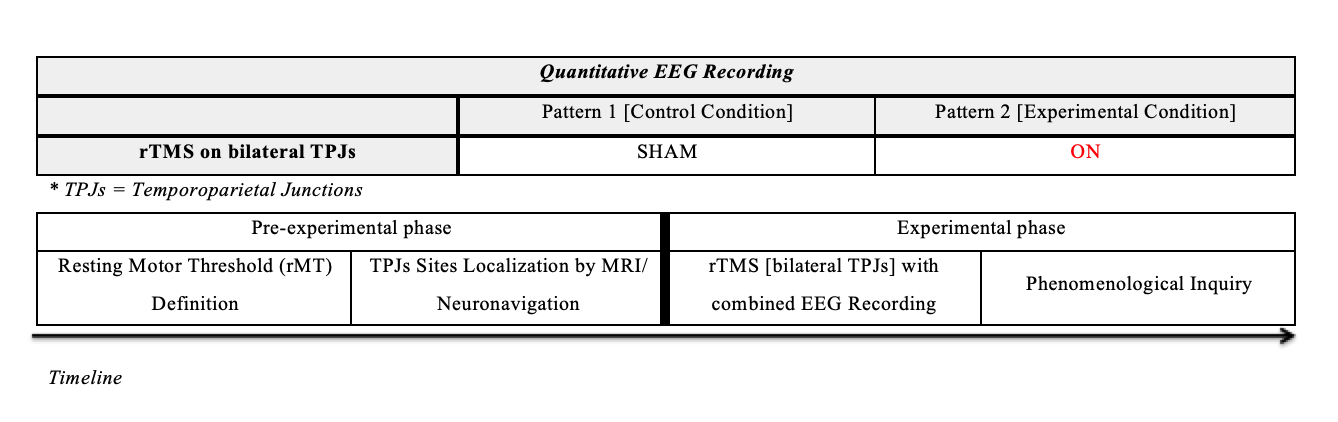
To examine the causal role of the TPJ in bodily self-awareness, and the neural dynamics hypothesized to underlie it (the desynchronization hypothesis), the experimental protocol combines a phenomenological inquiry — using embodiment scales administered before and after stimulation — with repetitive transcranial magnetic stimulation (rTMS) delivered to inhibit bilateral TPJ activity. Within- and between-subject effects are compared across experimental conditions, contrasting active inhibition against a sham condition.
Combined EEG analysis is used to identify variations in EEG power and to characterize possible correlations between TMS-induced abnormal body perception and cortical deactivation (desynchronization) across the scalp.