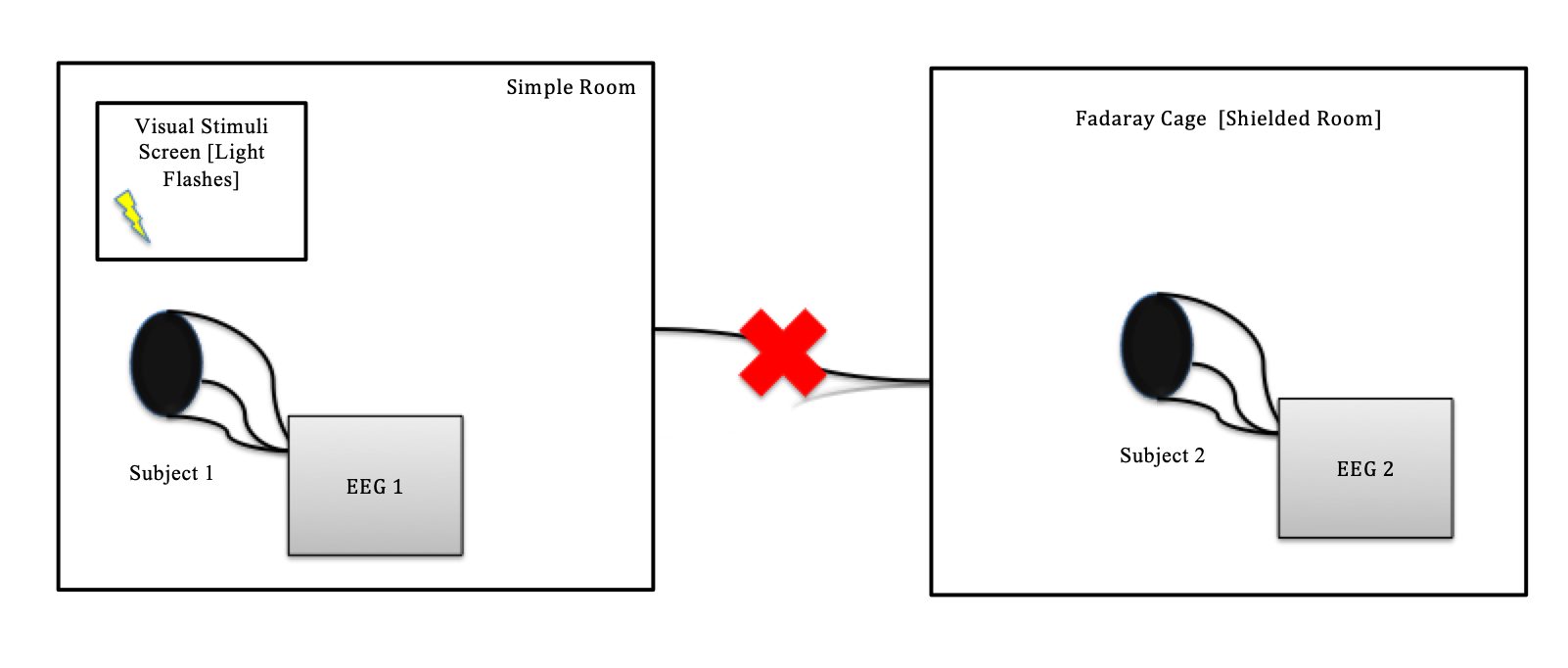
The Einstein–Podolsky–Rosen (EPR) paradox, first formulated in physics to describe nonlocal correlations between entangled particles, is used analogically in consciousness studies to describe reports of distant statistical correlations between human brains. Grinberg-Zylberbaum et al. (1994) reported the first statistically significant results of this kind, describing transferred potentials that appeared to demonstrate brain-to-brain nonlocal correlations between physically separated subjects — findings offered as provisional support for the hypothesis that large-scale brain activity may involve quantum-level processes, rather than as a settled result. This finding has not been independently replicated with rigorous methodology and remains a disputed, minority position in neuroscience and physics; it is presented here as a hypothesis PSI Research Center continues to test, not as an established phenomenon.
Subsequent researchers have proposed that microbiological and psychophysical processes inside the human brain might support large-scale, nonlocal information processing. Two complementary — and largely untested — hypotheses have shaped this line of inquiry. The Penrose–Hameroff model proposes that microtubules within neurons could support a form of quantum computation. The Holonomic Brain Theory, associated with Karl Pribram, proposes instead that memory and cognition are organized as holographic storage and computation within the brain's electromagnetic interference patterns. Neither hypothesis has achieved experimental consensus, but both motivate the empirical question this research program investigates: whether the anomalies described as nonlocal EPR correlations could constitute a rational, physiologically grounded basis for phenomena informally described as telepathy.
"Transferred potentials demonstrating brain-to-brain nonlocal correlations between physically separated subjects."
— Grinberg-Zylberbaum, Delaflor, Attie & Goswami, 1994
Methodology
Dual-EEG Protocol
Investigating the EPR hypothesis with quantitative precision requires a dual-electroencephalography experimental design. In the protocol used at PSI Research Center, one participant is seated, eyes closed, inside a soundproof, magnetically shielded Faraday cage; the second participant — typically the practitioner — is placed in an unshielded room, or in a second Faraday cage, to minimize the possibility of ordinary electromagnetic interference between the two.
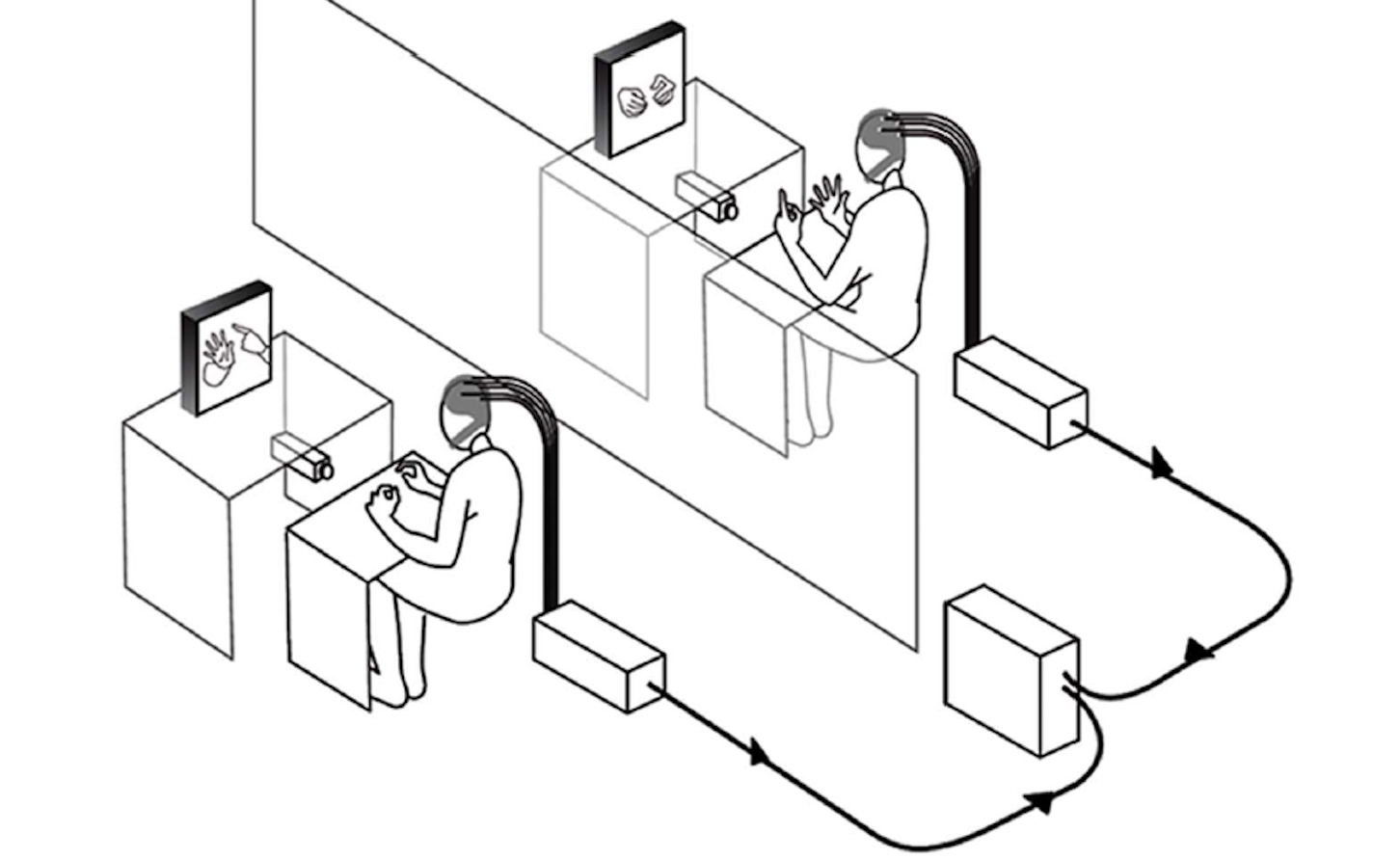
Analysis focuses on inter-brain network topology: phase synchronization (or neural synchrony), coherence, and inter-brain connectivity between the practitioner–subject pair. Two indices are used to quantify these relationships — the phase locking value (PLV), a standard measure of phase synchronization, and partial directed coherence (PDC), a spectral estimator derived from the Granger-causality principle that characterizes directed influence, or connectivity flow, between pairs of signals. Both are required to assemble a dataset capable of supporting, or falsifying, the hypothesis under rigorous statistical scrutiny.
Working Definition
Psychic Abilities
Within this research program, a psychic state is provisionally defined as a condition in which a measurable effect originating in one brain — that of the psychic or practitioner — is detectable in a second brain, or in surrounding waves or matter. This operational definition is intentionally narrow: it restricts the object of study to effects that are, in principle, instrumentable and falsifiable, rather than to subjective report alone.
Research Design
Experimental Set-up
The experimental protocol sits at the intersection of psychophysics and cognitive neuroscience. Its design is guided by a working model of expanded consciousness, the hypothesis of nonlocal occurrence between brains, and the practical means available to measure such occurrence — principally transcranial magnetic stimulation (TMS) and dual-EEG recording. Apparatus and protocol are described in further detail in the Research Axes and Scientific Apparatus sections of this site.