"The living being should not consider itself as matter animated by energy: it is the energy pre-existing the matter which directs the matter towards a process of life."
— Erwin Schrödinger, 1943
The Unified Consciousness Project (UCP) is Ken Mauron's culminating theoretical synthesis at PSI Research Center, weaving the EPR-correlation, biomagnetism and sound-medicine research described elsewhere on this site into a single integrative model. It draws deliberately on both physics and esoteric-hermetic tradition as a heuristic device for organizing hypotheses about consciousness; it is presented here as a theoretical proposal under active development, not as an empirically established account of consciousness.
Theoretical Foundations
A Unification of Hard and Hermetic Sciences
The UCP framework proposes treating consciousness as information carried by electromagnetic waves and fields, rather than as a byproduct of neural computation alone. Within this model, the degree of expansion of a given state of consciousness is treated as proportional to the amount of information integrated within an electromagnetic field, with altered states corresponding to shifts in that field's vibratory rate — a concept the framework relates to quantum resonance and to cymatics, the study of geometric patterns produced by vibration.
The model organizes this hypothesis around four parameters, mapped by analogy onto the four classical elements of hermetic tradition. Wavelength (fire) is treated as governing the availability of free energy, and by extension of information, with shorter wavelengths corresponding to higher energy and information content. Quantum entanglement, or the EPR paradox (air), is proposed as the resonance mechanism permitting an exchange of information across distance. The brain (earth) is framed not as the producer of consciousness but as the integrating center where physical and mental information fields combine into an emotional field. DNA (water) is treated as a phylogenetic memory space, encoding the informational history of the organism. The framework presents this fourfold structure as a heuristic mapping rather than an empirical finding.
Neurophysiological Hypothesis
The Holonomic Brain and the Mer-Ka-Ba Hypothesis
Building on Karl Pribram's Holonomic Brain Theory, the UCP framework proposes two complementary neurophysiological mechanisms by which distant or expanded states of consciousness might arise. The first treats brain-to-brain connection as a form of quantum entanglement, observable in principle through the phase-synchronization and coherence indices described in the EPR research on this site. The second proposes that disrupting activity at the temporo-parietal junctions could desynchronize the brain's two hemispheres, loosening the neuroanatomical constraints that ordinarily restrict the integration of information — a state the framework compares, speculatively, to reports of near-death experience.
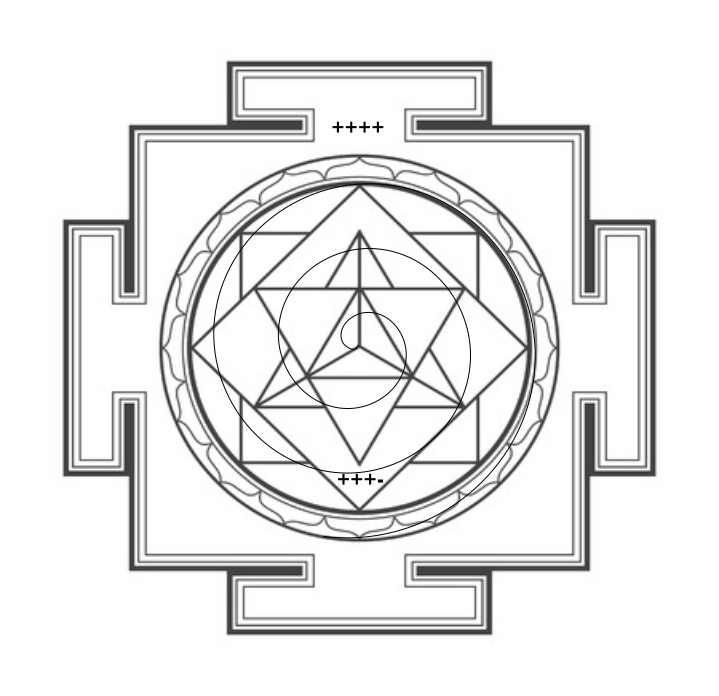
The framework further proposes that interference patterns among electromagnetic fields, hypothetically visible through phase-synchronization and coherence analysis, could form the geometric basis of consciousness. It extends this interference-pattern hypothesis beyond the brain to a whole-body energy field the framework terms — borrowing the name from esoteric tradition — the Mer-Ka-Ba: a standing electromagnetic waveform proposed to extend around the entire physical body rather than being confined to the head.
Theoretical Model
Temporal Consciousness and Space Consciousness
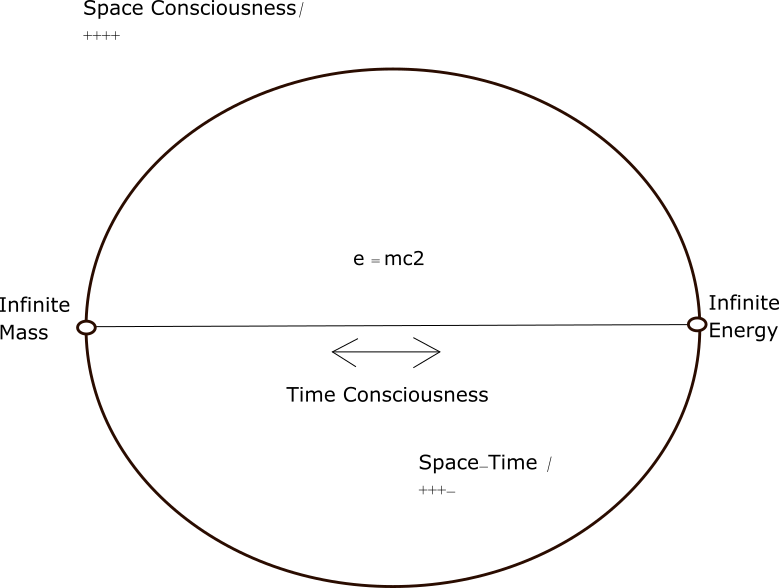
The UCP framework distinguishes two proposed states: a duality of space-time, and a state of unity outside it. Temporal consciousness is associated with constrained energy, causality, physicality and the macro-environment; space consciousness is associated with free energy, non-locality, timelessness and total quantum resonance. The framework proposes an intermediate zone at the Planck scale — described by analogy with esoteric tradition as an akashic field — through which consciousness is hypothesized to move between these two states via increasing quantum resonance. It further borrows Hilbert-space formalism, purely as a metaphorical device, to describe this movement as traversal through nested, holarchic "dimensional spaces" rather than as a literal physical claim.

Theoretical Model
The Evolution of Consciousness
The framework describes the evolution of consciousness through the principle of negentropy — the inverse of entropy — by which structured, resonant information is proposed to allow consciousness to manifest, as opposed to chaotic or contrasting information states. Under this hypothesis, an increase in vibratory rate is associated with a decrease in the perceived passage of time, framed as a phenomenological correlate rather than a claim about physical time itself. Temporal consciousness and space consciousness are described as orthogonal axes; movement toward space consciousness is framed as movement toward increased quantum resonance with the surrounding environment.